Interbody Wire for Reconfigurable Robots:
Bridging Integrated Morphological Reconfiguration
and Distributed Wire-Mediated Cooperation
Advanced Intelligent Systems
Abstract
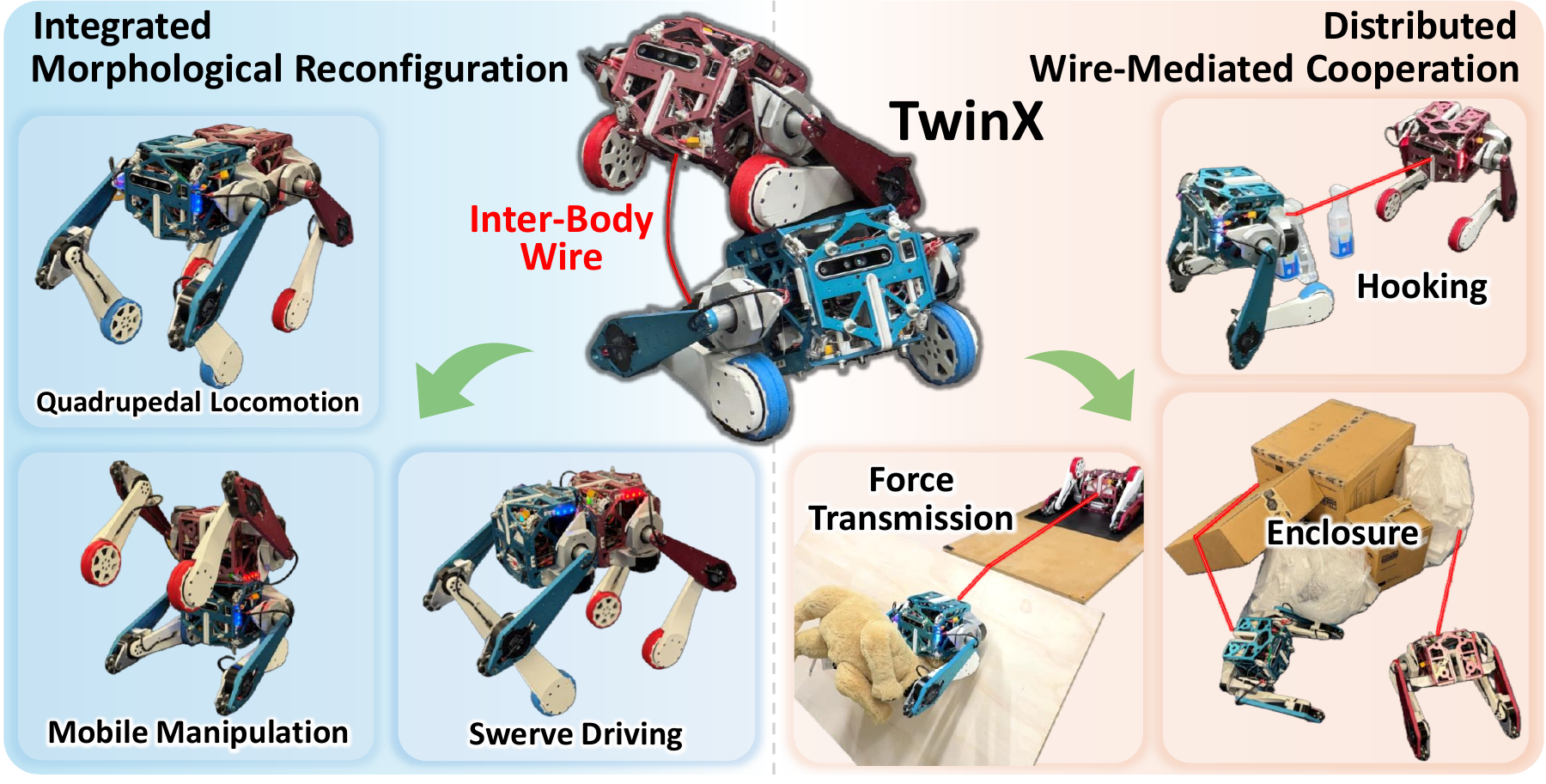
Reconfigurable robots address diverse tasks, including locomotion and object manipulation, by changing body configurations. In particular, modular robots expand body functions by connecting multiple body elements into various structures. However, these elements are typically mechanically fixed, and the focus is on functions as a single body after docking. This study proposes TwinX, a robot system in which a single inter-body wire connects integrated morphological reconfiguration in the docked state and functional relations among distributed bodies in the separated state. TwinX consists of two wheeled-legged robots connected by this wire, and docks and reconfigures by winding it. Even when the two bodies are distributed, the same wire can be used for object manipulation and force transmission. Real-robot experiments show quadrupedal and swerve-drive locomotion in the docked state, as well as object manipulation using the mobile manipulator configuration. They also show enclosure, hooking, and force-transmission tasks in the distributed state. These results show that the inter-body wire extends functional expansion through changes in body configuration to include distributed body relations. Furthermore, it positions the inter-body wire as a design element for robot bodies that is different from rigid links and joints because it enables maintained, variable-length, and tension-based relations between body elements.
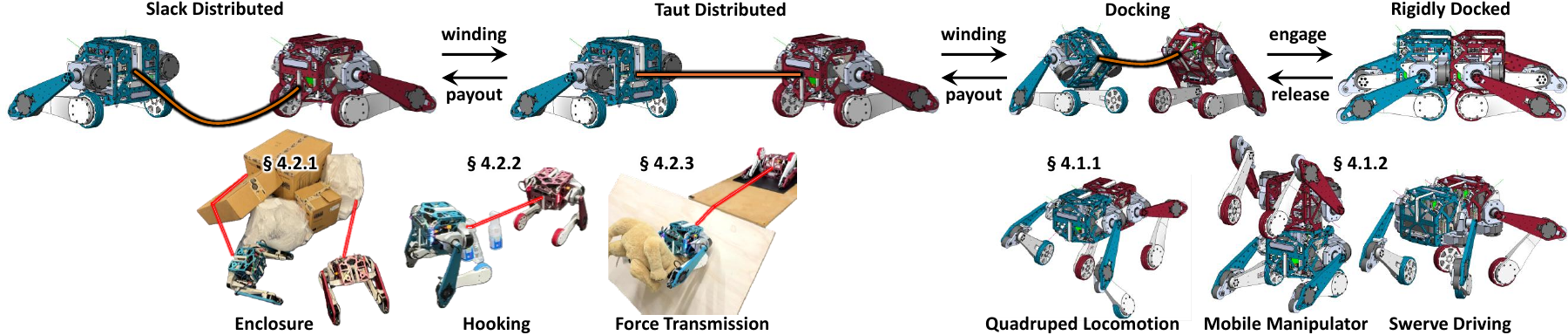
One wire, two functional states
Winding the inter-body wire brings the two robots together. Once the docking interfaces engage, wire tension provides preload for an integrated body. Paying out the wire allows the robots to separate while retaining a physical connection for cooperation.
Interbody Wire and Docking Mechanism
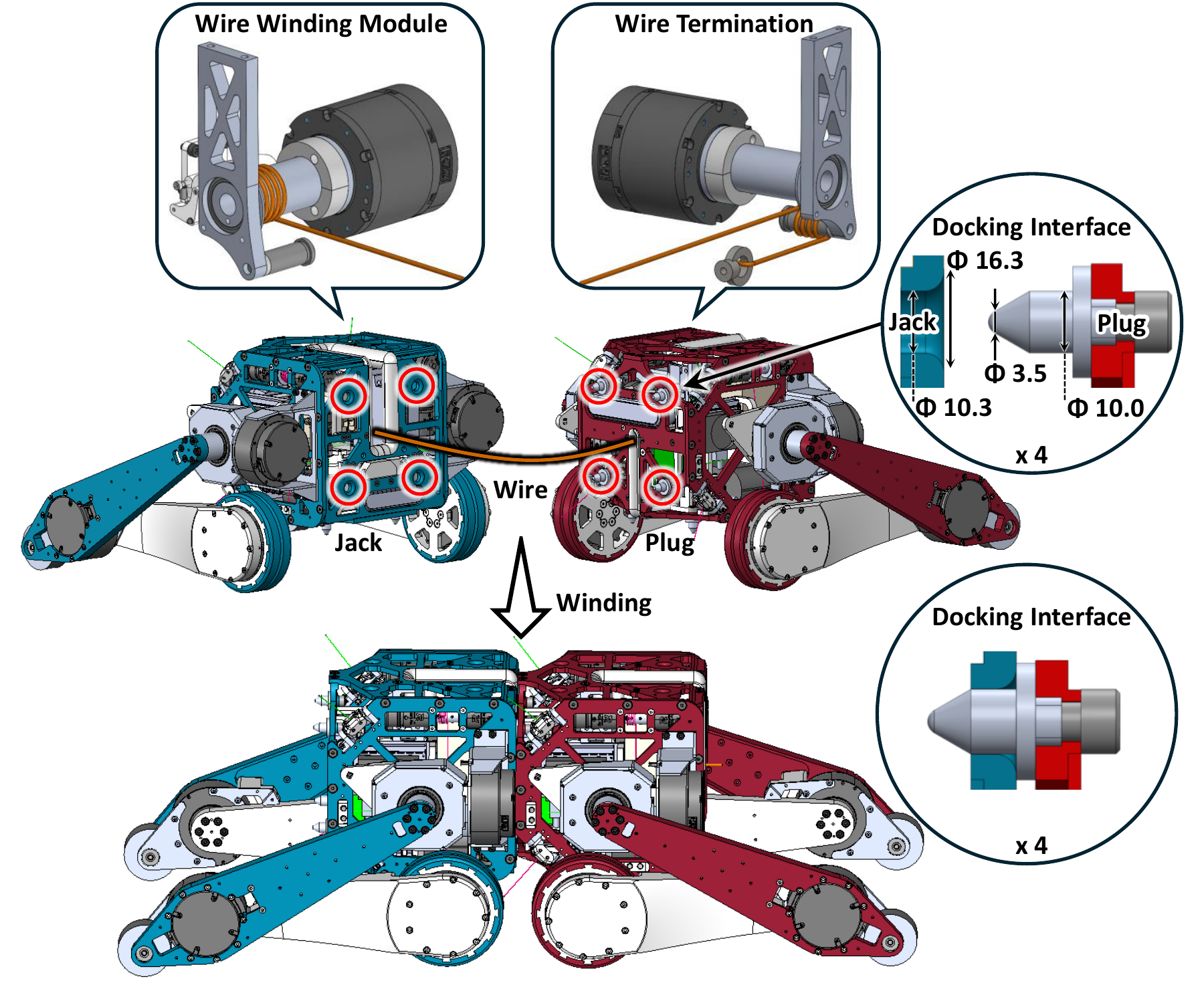
TwinX connects two identical wheeled-legged robots, WiXus-Blue and WiXus-Red, through a single actively wound wire. The winding module on WiXus-Blue retracts the wire attached to WiXus-Red, drawing the two bodies together.
The wire provides tensile preload, while four docking pins and matching sockets constrain bending and torsion at the interface. Tapered pin tips and widened socket entrances ease alignment during engagement. Together, the wire and docking interfaces turn the two robots into an integrated body.
Body Configurations and Reconfiguration
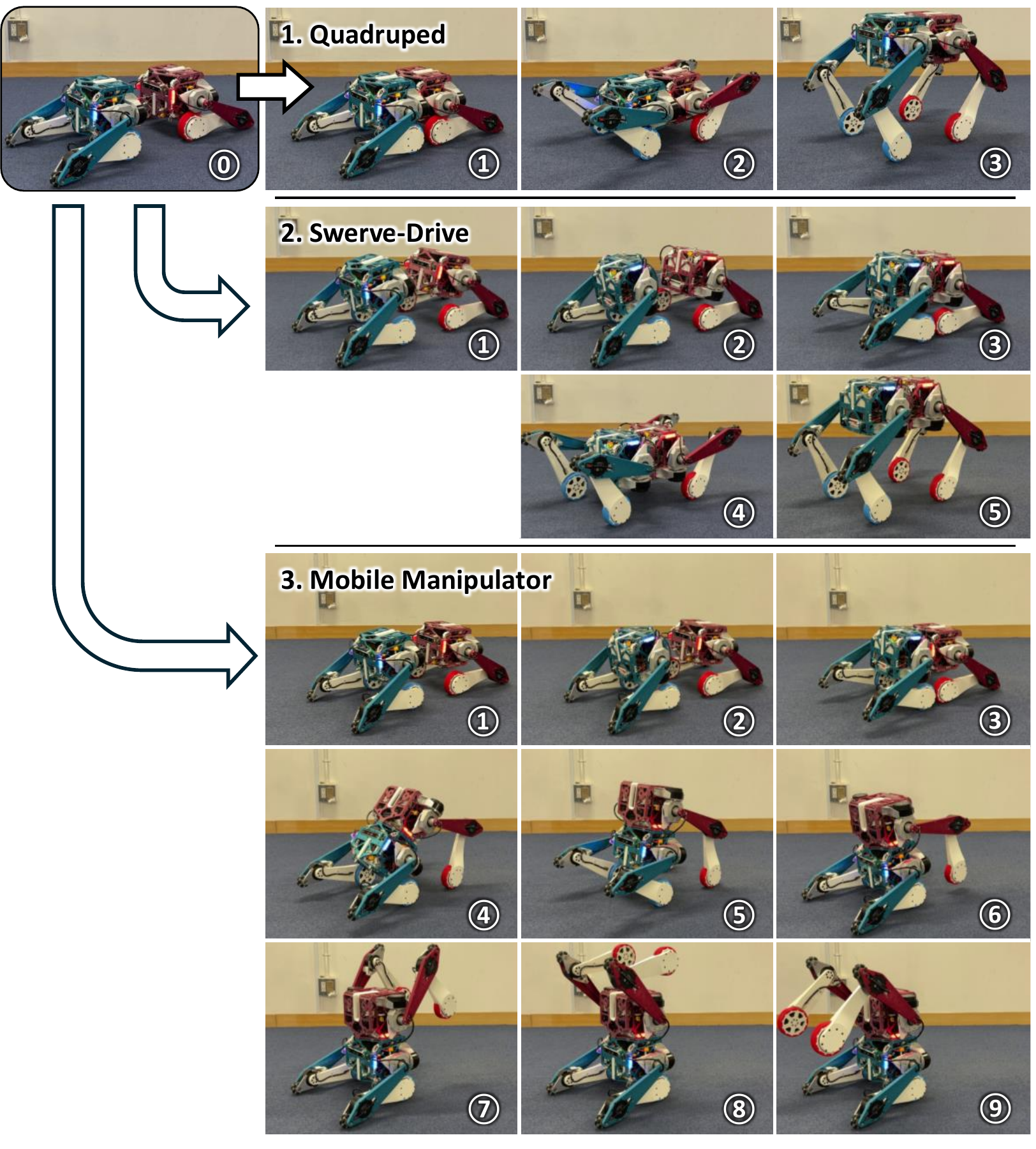
Each body offers two docking faces, A and B. A shared slit lets the wire move between the faces as the wheeled legs rotate the body, so selecting the mating faces changes the resulting joint arrangement.
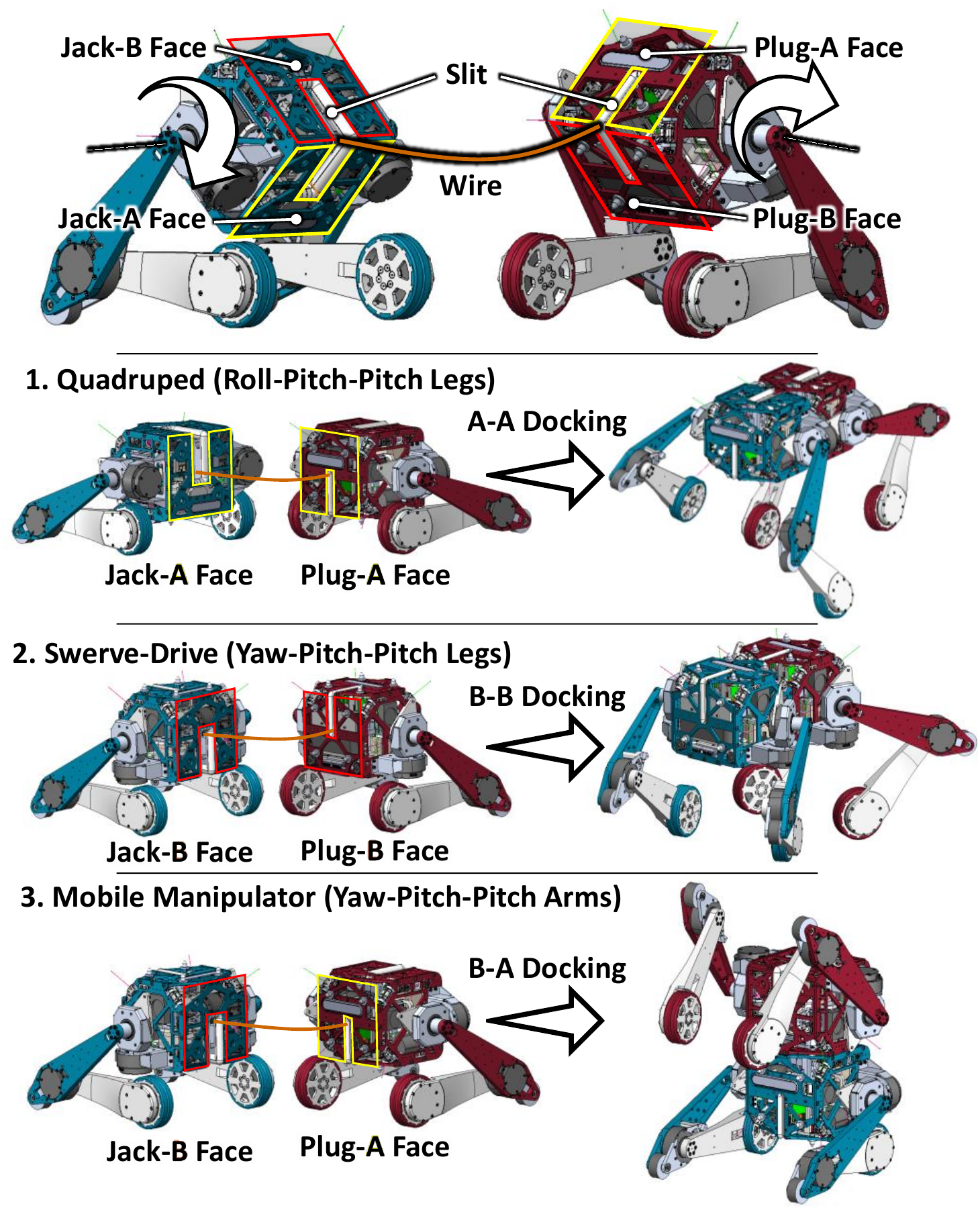
- Quadruped · A–A docking
- Four roll–pitch–pitch legs combine wheel-driven motion with legged locomotion over uneven terrain.
- Swerve drive · B–B docking
- Four yaw–pitch–pitch legs allow the wheels to steer independently for planar locomotion.
- Mobile manipulator · B–A docking
- With WiXus-Blue below WiXus-Red, two yaw–pitch–pitch arms sit above a differential two-wheel base.
After selecting the docking faces, commanded wheeled-leg joint trajectories move the docked bodies into the target configuration. Wire tension maintains preload while the interfaces constrain relative motion.
Autonomous Approach and Docking
WiXus-Red uses an AR marker on WiXus-Blue to approach the stationary robot. The controller first brings the moving body to a target position, then aligns its heading so the docking pins can enter the sockets.
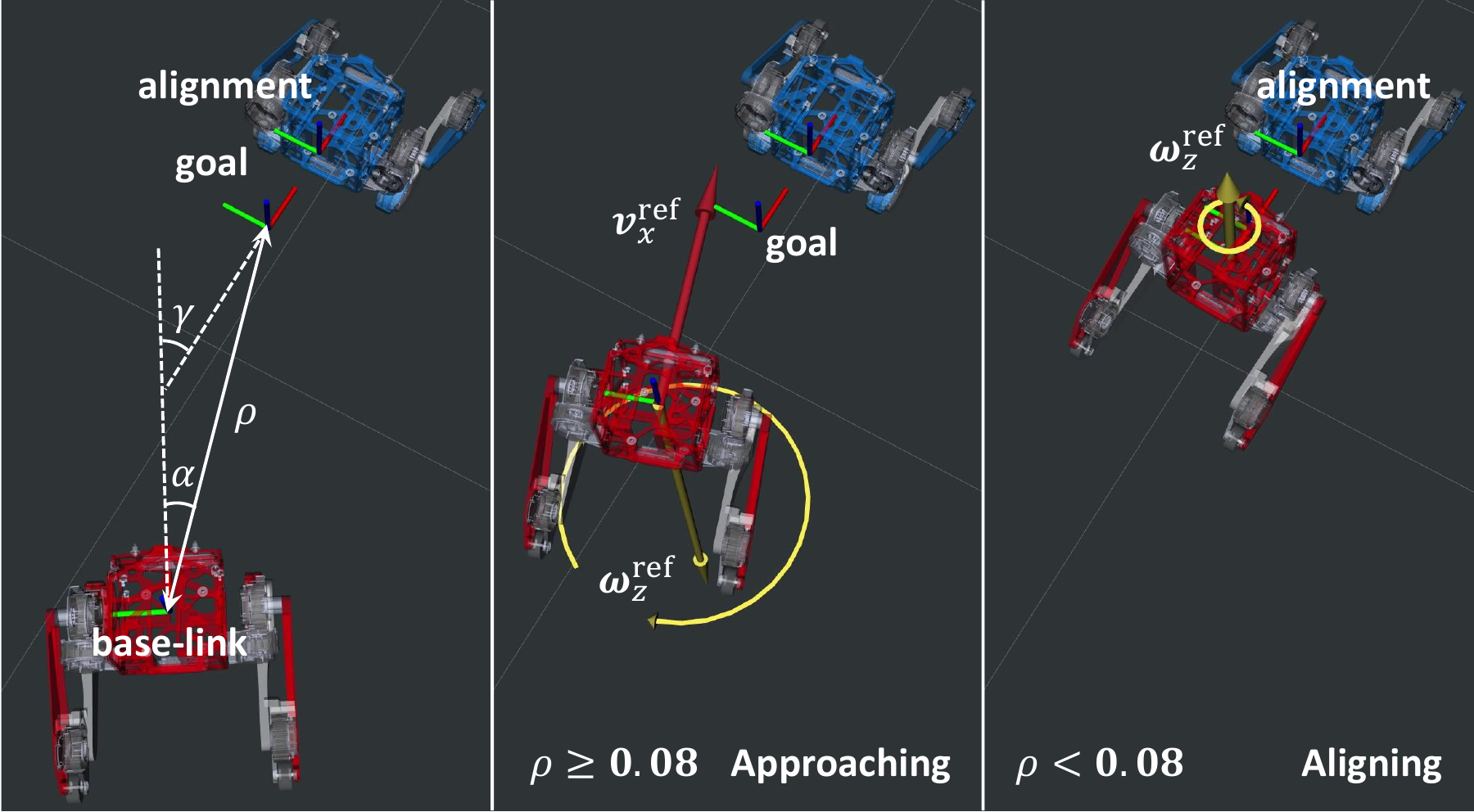
During approach, a small wire-tension command keeps the connection from becoming slack. Once the bodies are aligned, the winding module pulls them together to engage the docking interface. This sequence links visual alignment, wire actuation, and mechanical docking.
System Architecture and Control
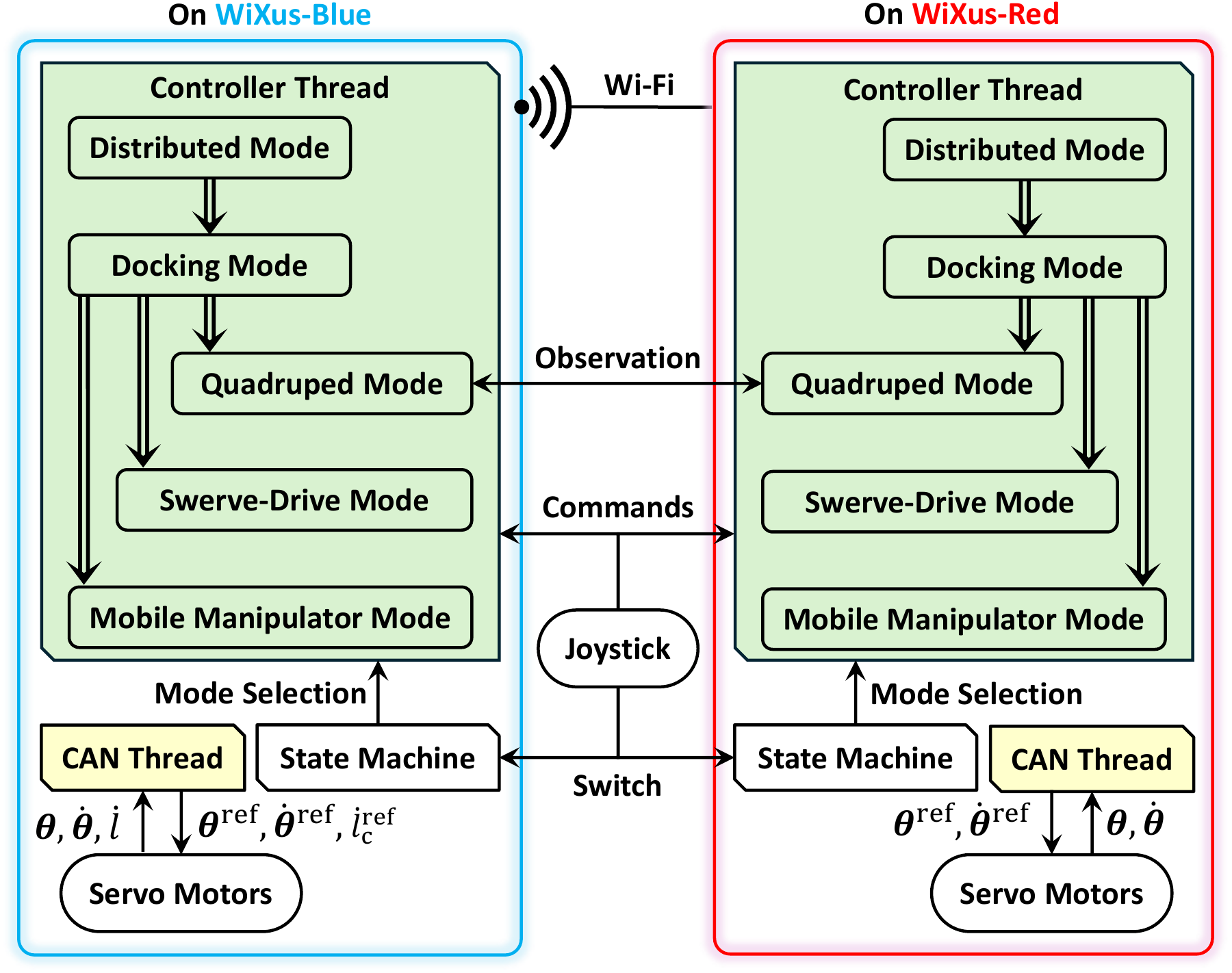
Both bodies run the same software architecture. A state machine selects separated, docking, quadruped, swerve-drive, or mobile manipulator operation. Shared joystick inputs and mode-specific references are converted into actuator commands through a CAN thread.
Quadrupedal Locomotion
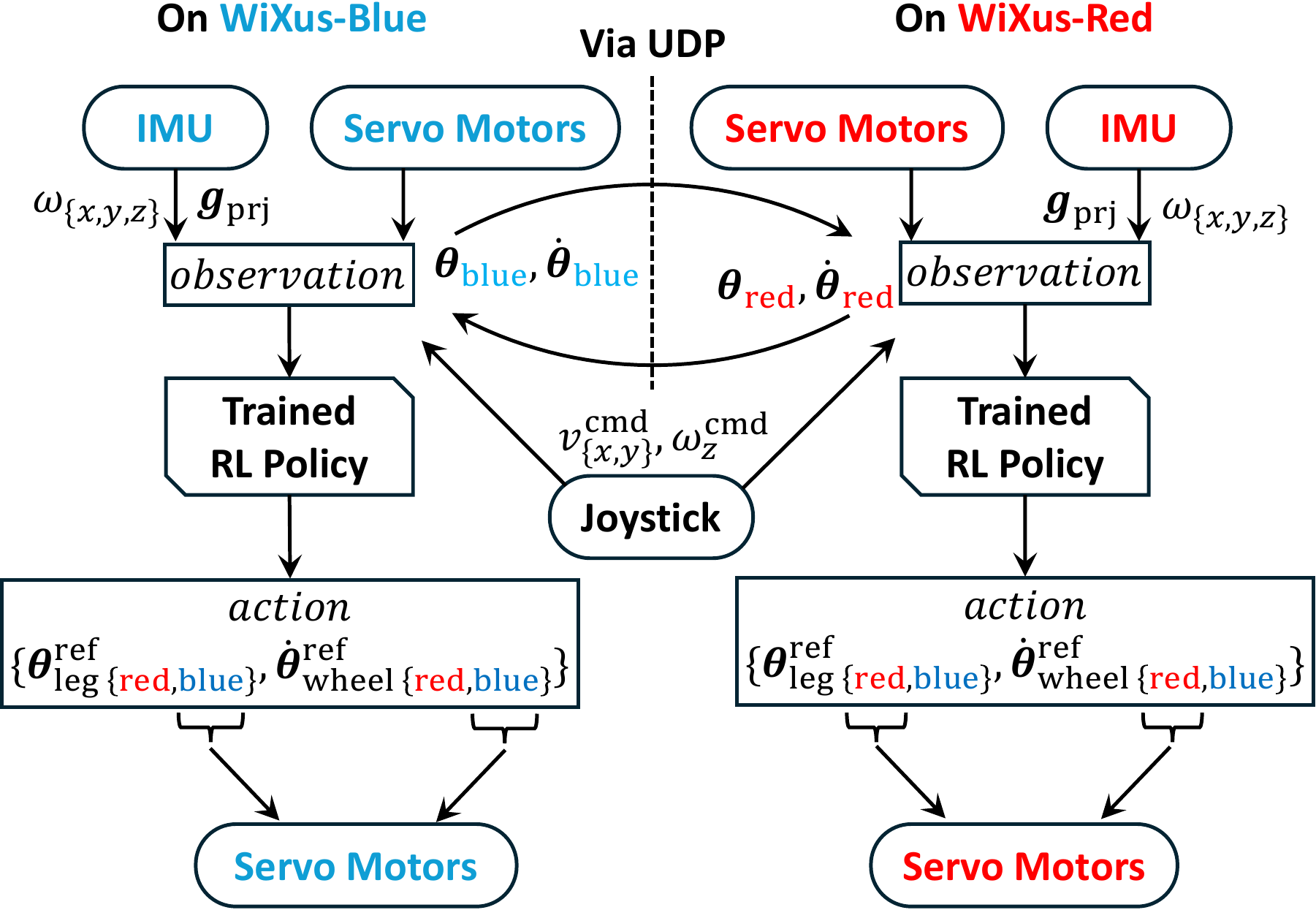
A PPO policy is trained in simulation with Legged Gym, treating the docked pair as a single quadruped. It commands twelve leg joints and four wheels. The two bodies exchange observations over Wi-Fi to execute the locomotion controller.
Swerve Drive and Mobile Manipulation
In swerve mode, target body translation and rotation are converted into steering angles and wheel speeds for each wheeled leg. In mobile manipulator mode, WiXus-Red controls the two arms while WiXus-Blue drives the base; filtered velocity commands smooth the motion.
Distributed Wire-Mediated Cooperation
When separated, each body operates as a two-wheel vehicle. The wire can be wound or paid out in coordination with translation, and the leg joints adjust body height. Body arrangement and wire actuation jointly support enclosure, hooking, and force transmission.
Experiments
Real-robot demonstrations explore the functions of both docked and distributed configurations.
Integrated Body Functions: Locomotion and Mobile Manipulation
In the docked state, TwinX forms one integrated body. The quadruped walks through grass, descends stairs, and steps over a curb. Reconfiguration also enables swerve-drive locomotion and mobile manipulation, demonstrated in a trash-collection task.
Distributed Cooperation: Enclosure, Hooking, and Force Transmission
After separation, the same wire remains a functional connection. The robots enclose and hook targets by coordinating their positions and wire actuation. A taut wire also transmits force between the bodies, allowing one body to support the other.
BibTeX
@article{inoue2026bridging,
  title = {Interbody Wire for Reconfigurable Robots: Bridging Integrated Morphological Reconfiguration and Distributed Wire-Mediated Cooperation},
  author = {Inoue, Shintaro and Kawaharazuka, Kento and Yoneda, Keita and Yuzaki, Sota and Suzuki, Temma and Okada, Kei},
  journal = {Advanced Intelligent Systems},
  year = {2026},
  pages = {e70559},
  doi = {10.1002/aisy.70559}
}
Contact
If you have any questions, please feel free to contact Shintaro Inoue.